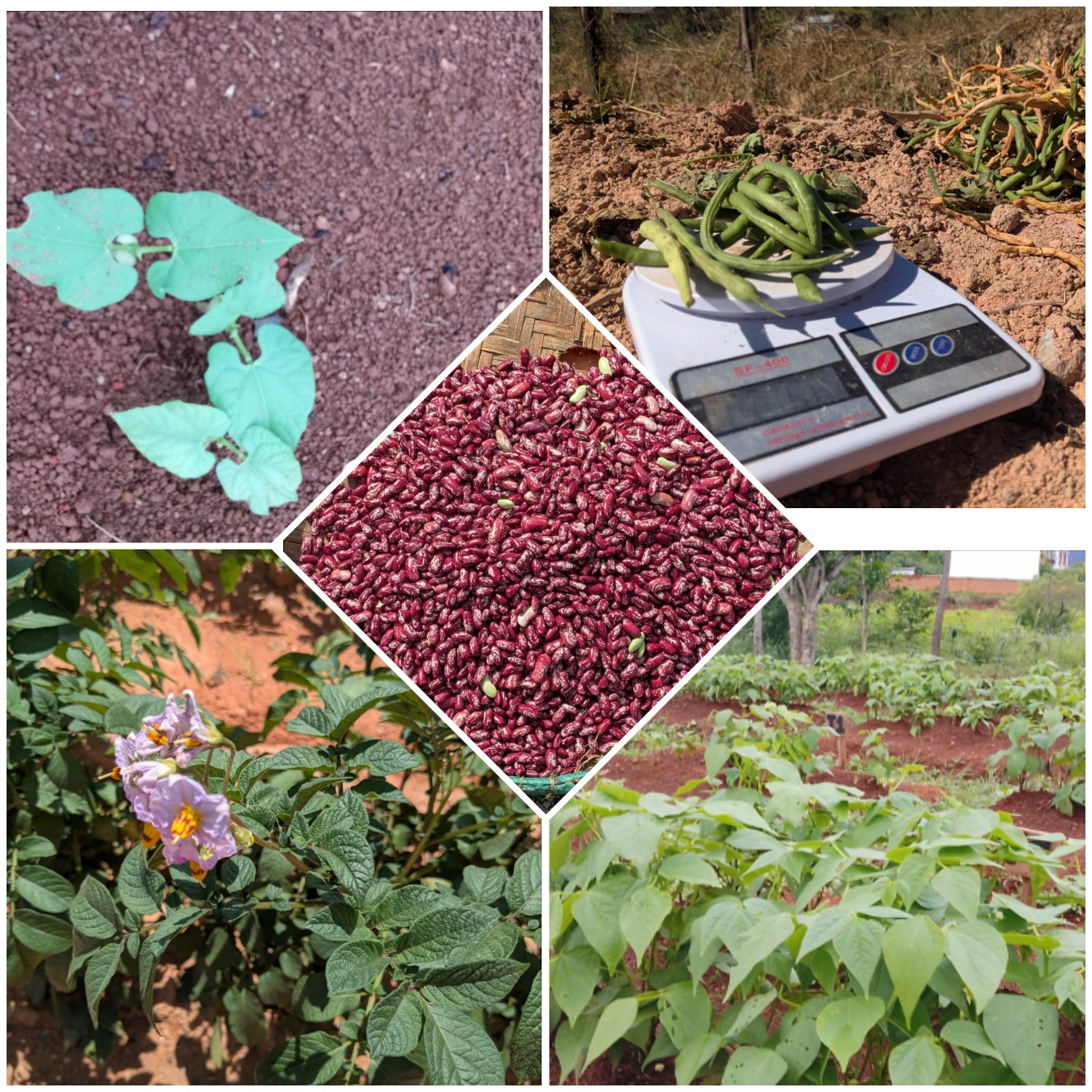
The warm and rainy cropping season concluded with the harvest of green beans at our research site in Ambohidray, Analamanga Region.
During this growing season, our research activities focused on developing practical solutions to improve agricultural productivity through field-based experimentation. The main studies included determining the optimum planting density for green beans, evaluating the effects of ridge cultivation, investigating the causes of leaf dieback in leeks, and comparing potato productivity under purely organic fertilization and conventional mineral fertilization.
The findings revealed several important outcomes:
• Cultivating beans on 20-cm-high ridges, combined with appropriate fertilization, significantly improves crop productivity by enhancing soil drainage, aeration, and root development.
• Leaf dieback in leeks is caused by multiple interacting factors, including water stress, nutrient deficiencies or imbalances, and pest or disease attacks. Effective irrigation management, balanced fertilization, and regular phytosanitary monitoring are therefore essential to minimize crop losses.
• Potato is a highly nitrogen-demanding crop. The application of nitrogen-rich organic fertilizers, such as poultry manure and well-decomposed farmyard manure supplemented with horn meal, substantially enhances plant growth and tuber yield.
• For green bean production during the rainy season, a planting spacing of 50 cm between rows and 25 cm between plants provides the optimum plant density for maximizing yield while reducing competition among plants.
The cool and dry growing season began in April with the establishment of carrot trials at our research site in Tsarasaotra, Amoron'i Mania Region.
Current research activities primarily focus on developing innovative strategies for efficient water management and evaluating biological approaches to pest and disease management. Particular emphasis is placed on controlling fungal diseases, whose development is favored by the cool and humid conditions typical of this season.
In addition, a wide range of crop trials will be conducted across our ten research sites. Crop selection is carried out in close collaboration with our farmer co-researchers and is based on the dominant agricultural commodities and the production constraints identified within each locality. The current research program focuses particularly on strategic crops such as carrot, potato, green beans, pak choï , zucchini, salad and tomato, with the objective of developing innovative, sustainable, and field-tested solutions that can be readily adopted by farmers to improve productivity and strengthen the resilience of their farming systems.
During this growing season, our research activities focused on developing practical solutions to improve agricultural productivity through field-based experimentation. The main studies included determining the optimum planting density for green beans, evaluating the effects of ridge cultivation, investigating the causes of leaf dieback in leeks, and comparing potato productivity under purely organic fertilization and conventional mineral fertilization.
The findings revealed several important outcomes:
• Cultivating beans on 20-cm-high ridges, combined with appropriate fertilization, significantly improves crop productivity by enhancing soil drainage, aeration, and root development.
• Leaf dieback in leeks is caused by multiple interacting factors, including water stress, nutrient deficiencies or imbalances, and pest or disease attacks. Effective irrigation management, balanced fertilization, and regular phytosanitary monitoring are therefore essential to minimize crop losses.
• Potato is a highly nitrogen-demanding crop. The application of nitrogen-rich organic fertilizers, such as poultry manure and well-decomposed farmyard manure supplemented with horn meal, substantially enhances plant growth and tuber yield.
• For green bean production during the rainy season, a planting spacing of 50 cm between rows and 25 cm between plants provides the optimum plant density for maximizing yield while reducing competition among plants.
The cool and dry growing season began in April with the establishment of carrot trials at our research site in Tsarasaotra, Amoron'i Mania Region.
Current research activities primarily focus on developing innovative strategies for efficient water management and evaluating biological approaches to pest and disease management. Particular emphasis is placed on controlling fungal diseases, whose development is favored by the cool and humid conditions typical of this season.
In addition, a wide range of crop trials will be conducted across our ten research sites. Crop selection is carried out in close collaboration with our farmer co-researchers and is based on the dominant agricultural commodities and the production constraints identified within each locality. The current research program focuses particularly on strategic crops such as carrot, potato, green beans, pak choï , zucchini, salad and tomato, with the objective of developing innovative, sustainable, and field-tested solutions that can be readily adopted by farmers to improve productivity and strengthen the resilience of their farming systems.