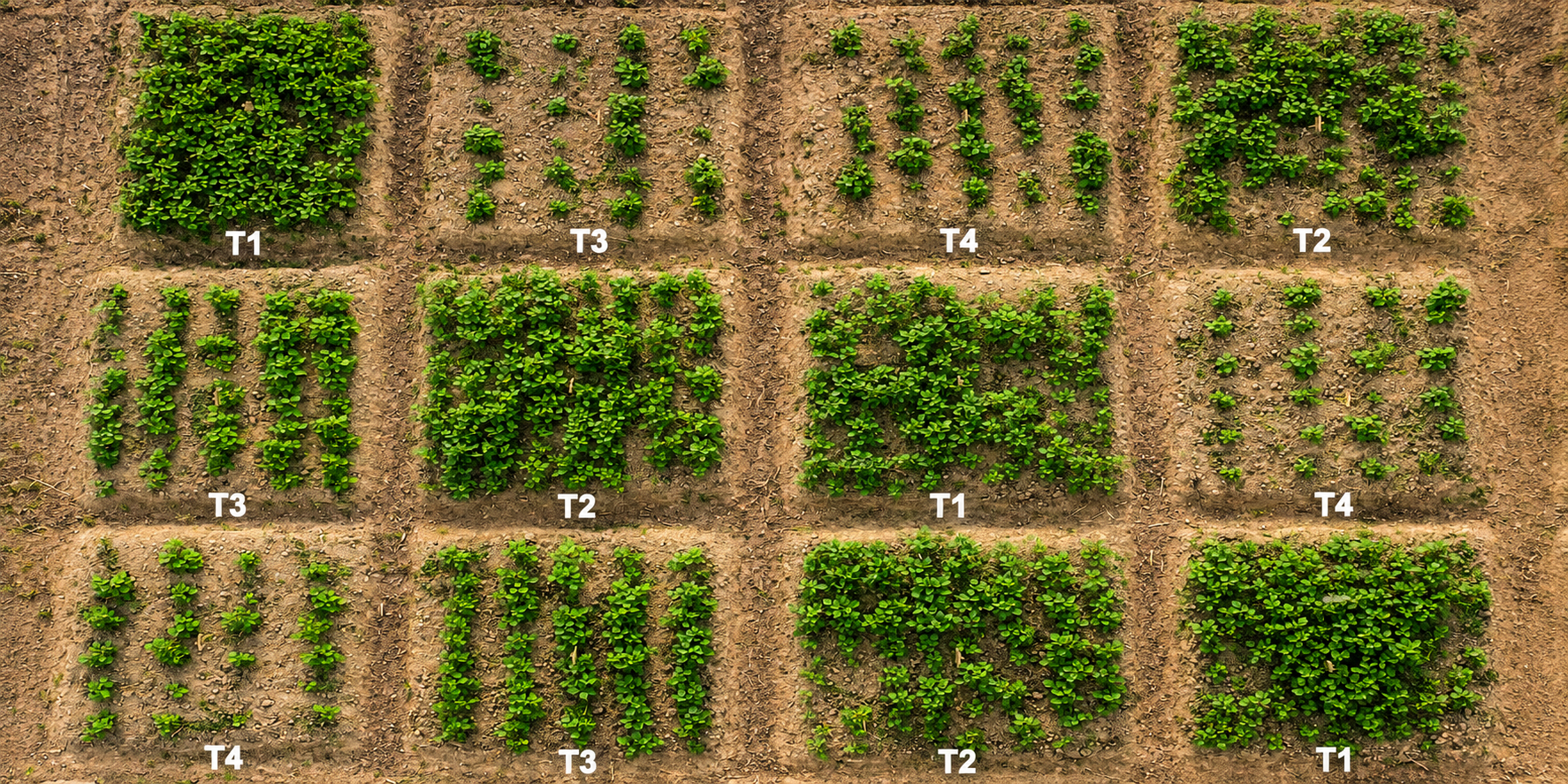
Does the spacing between plants and rows affect bean production?
To answer this question a comparative study was carried out to evaluate four planting configurations:
• T1: traditional farming practice (the layout typically used by growers)
• T2: 20 cm between plants × 20 cm between rows
• T3: 25 cm between plants × 50 cm between rows
• T4: 30 cm between plants × 50 cm between rows
Plant growth: greater height does not necessarily mean green bean production?
Plants in treatment T2 grew to the average height followed by plants in treatment T3 then plants in treatment T1 and finally plants in treatment T4. However the differences in height were not statistically significant. This pattern may be due to increased competition for light in plantings, which causes plants to stretch in order to capture more light.
Regarding the number of leaves the average number ranged from 16 to 18 leaves per plant. Because the differences were not significant no single treatment stood out based on leaf number.
Number of pods: the importance of spacing
The number of pods per plant was higher in treatments T2, T3 and T4. This pattern may be linked to availability of resources such as water, light and nutrients and to a lower spread of pests and diseases between plants. In fact plots with planting density also had a lower disease index.
Yield: finding the balance between density and productivity
Treatments T2 and T3 produced the highest yields. However plants in treatment T4 showed a delay in maturation compared to plants in the treatments. Because of this difference in maturity it is not possible to compare yields fairly among the treatments.
What planting density should be chosen for bean cultivation?
The results of this trial show the importance of a considered planting density. While closer spacing uses the cultivated area intensively appropriate spacing promotes better plant development, pod formation and overall crop health.
Under the conditions of this trial, treatment T3 (25 cm between plants × 50 cm between rows) emerges as the option to recommend. Treatment T3 balances space utilization, plant development and productivity and also yields results for crop health.
This recommendation should be verified under soil and climatic conditions and with various plant varieties to determine its relevance, in a broader range of production contexts.