Potato is a high-value crop that contributes to food security among farming households in the central highlands of Madagascar. However, the high cost of certified seed potatoes encourages smallholder farmers to reuse farm-saved seeds, leading to seed degeneration and declining yields. This study aimed to evaluate the effects of four fertilizers on the growth and yield of the “Maneva mena” (G5) potato variety in Talata Volonondry, Analamanga Region.
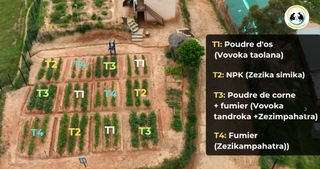
A randomized complete block design with three replications compared four treatments: bone meal alone (T1), mineral NPK 11-22-16 fertilizer (T2), a combination of zebu cattle manure and horn meal (T3), and cattle manure alone (T4). The measured parameters included emergence rate, plant height, leaf number, tuber mass, and overall yield.
The results showed that fertilizers had no significant effect on emergence rate, which reached nearly 100% by the 16th day after planting. However, significant effects were observed on leaf number (F = 47.08; p < 2 × 10⁻¹⁶), plant height (F = 16.49; p = 3.31 × 10⁻¹⁰), tuber mass (F = 12.70; p = 3.21 × 10⁻⁷), and overall yield (p = 0.0434). Treatment T3 achieved the best overall performance, whereas T4 produced the weakest results.
The combination of cattle manure and horn meal therefore represents a promising fertilization alternative for improving potato productivity under the conditions studied. This combination is recommended for consideration in similar production systems. Further trials should confirm its agronomic effectiveness under different soil and growing conditions before broader recommendations are made.