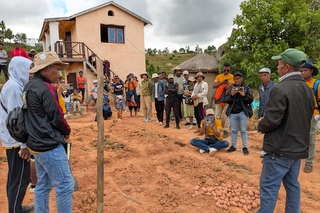
This agricultural extension article presents the results of a field trial conducted at the Minimal Irrigation Project (MIP) demonstration site in Mahavariana, Talata Volonondry, in Madagascar’s Analamanga region. Its main objective is to help farmers identify effective, locally accessible, and economically beneficial fertilizers for improving potato production.
Four treatments were compared: bone meal, mineral NPK 11-22-16 fertilizer, a combination of zebu manure and horn meal, and manure alone. The results show that the manure–horn meal combination performed best, producing an average plant height of 40 cm, approximately 60 leaves per plant, and a yield of 8.4 t/ha. NPK ranked second, yielding 8.2 t/ha, followed by bone meal at 6.3 t/ha and manure alone at 6 t/ha.
Horn meal is rich in organic nitrogen and gradually releases nutrients required for plant growth, while manure improves soil structure and water retention. It also provides practical recommendations, including using good-quality seed tubers, preparing the soil to a depth of approximately 25 cm, and applying fertilizers before planting.
This article emphasizes practical application rather than detailed experimental methodology and statistical analysis. It translates research findings into straightforward recommendations that farmers can implement in their fields. It also highlights the economic benefits of treatment T3, which reportedly generated a gross margin of 130,300 Malagasy ariary per 48 m². However, this result reflects the conditions of the specific trial and may vary across farms and production environments.
This article emphasizes practical application rather than detailed experimental methodology and statistical analysis. It translates research findings into straightforward recommendations that farmers can implement in their fields. It also highlights the economic benefits of treatment T3, which reportedly generated a gross margin of 130,300 Malagasy ariary per 48 m². However, this result reflects the conditions of the specific trial and may vary across farms and production environments.