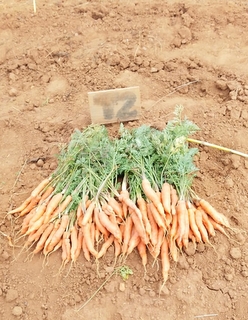
Given increasing water scarcity and the widespread use of flood irrigation in Malagasy family farms, this study aimed to determine an irrigation frequency that reduces water inputs while maintaining an acceptable carrot yield (Daucus carota L., Nantaise variety). Three trials were conducted from 2024 to 2026 in the Amoron’ny Mania Region, Madagascar, at two sites with different soil characteristics: Ambalamahasoa and Tsinjony.
A randomized complete block design with three replications compared three irrigation regimes: every two days (T1, reference), every three days (T2), and every four days (T3), with 5 L/m² applied per irrigation. All plots received compost at 10 t/ha. Data were analyzed using analysis of variance (ANOVA), followed by Tukey’s test.
The results showed no significant differences between T1 and T2 in root mass, length, or diameter. In contrast, T3 reduced root mass by 25–30%, root length by 28–29%, and root diameter by 27–28%. Across the three years, mean yield reached 5.81 kg per 3 m² plot under T1, compared with 4.26 kg under T2 and 3.03 kg under T3. Thus, T2 achieved approximately 73% of the reference yield, whereas T3 achieved only 52%. The ranking of treatments remained stable across trials.
Irrigation every three days could provide an alternative for reducing water inputs, provided that the observed yield reduction is considered acceptable. Irrigation every four days appears poorly suited to the conditions studied. Further research is recommended to assess marketable roots, evapotranspiration, and the effects of irrigation frequency separately from irrigation volume.