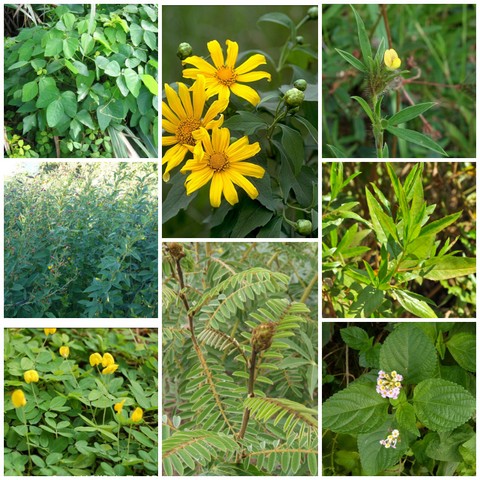
Did You Know? Not All Plants Are Equal in Your Compost!
When we think of compost or green manure, we often picture a simple pile of decomposing plant material. But the plants that go into it matter far more than most people realize — their nutrient content varies tremendously from one species to the next, and those differences directly affect soil fertility and crop productivity.
Leguminous plants, recognizable by their pods, such as Mucuna pruriens (velvet bean), Cajanus cajan (pigeon pea), or Tephrosia vogelii (known locally as “famamo”, possess a remarkable ability: they can capture atmospheric nitrogen and store it in the soil, thanks to bacteria living in their roots. Yet beyond this specific capability, the nutrient content of each type of biomass is unique. Scientific studies have made it possible to rank them from richest to poorest for each element essential to plant nutrition.
Ranking of biomasses, sorted from richest to poorest for each element;
v Nitrogen richness (N): Tephrosia vogelii (Mg:Famamo)– Mucuna pruriens - Tithonia diversifolia (Mg:Bemangidy) – Cajanus cajan – Arachis pintoi – Stylosanthès – Lantana camara (Mg:Radriaka) – Psiadia altissima (Mg:Dingadingana)
v High phosphorus content (P): Tephrosia vogelii (Mg:Bemangidy) – Tithonia diversifolia (Mg:Bemangidy) – Mucuna pruriens – Cajanus cajan – Arachis pintoi – Stylosanthès – Lantana camara (Mg:Radriaka) – Psiadia altissima (Mg:Dingadingana)
v High potassium content (K) : Tithonia diversifolia (Mg:Bemangidy) – Tephrosia vogelii (Mg:Bemangidy) – Mucuna pruriens – Cajanus cajan – Arachis pintoi – Lantana camara (Mg:Radriaka) – Stylosantès – Psiadia altissima (Mg:Dingadingana)
v High in calcium (Ca) : Lantana camara (Mg:Radriaka) – TTithonia diversifolia (Mg:Bemangidy) – Tephrosia vogelii (Mg:Bemangidy) – Cajanus cajan – Tephrosia vogelii (Mg:Bemangidy) – Stylosanthès – Mucuna pruriens – Psiadia altissima (Mg:Dingadingana)
v Rich in magnesium (Mg): Tithonia diversifolia (Mg:Bemangidy) – Tephrosia vogelii (Mg:Bemangidy) – Arachis pintoi – Mucuna pruriens – Cajanus cajan – Lantana camara (Mg:Radriaka) – Stylosanthès – Psiadia altissima (Mg:Dingadingana)
v High sulfur content (S): Tithonia diversifolia (Mg:Bemangidy) – Tephrosia vogelii (Mg:Bemangidy) – Cajanus cajan – Mucuna pruriens – Stylosanthès – Lantana camara (Mg:Radriaka) – Arachis pintoi – Psiadia altissima (Mg:Dingadingana)
v Rich in zinc (Zn) : Tithonia diversifolia (Mg:Bemangidy) – Cajanus cajan – Mucuna pruriens – Tephrosia vogelii (Mg:Bemangidy) – Arachis pintoi- Stylosanthès – Psiadia altissima (Mg:Dingadingana) – Lantana camara (Mg:Radriaka)
v Rich in Iron (Fe) : Tithonia diversifolia (Mg:Bemangidy) – Psiadia altissima (Mg:Dingadingana) – Mucuna pruriens – Cajanus cajan – Tephrosia vogelii (Mg:Bemangidy) – Stylosanthès – Arachis pintoi – Lantana camara (Mg:Radriaka)
v Rich in manganese (Mn) : Lantana camara (Mg:Radriaka) – Tithonia diversifolia (Mg:Bemangidy)- Mucuna pruriens – Cajanus cajan – Tephrosia vogelii (Mg:Bemangidy) – Arachis pintoi – Stylosanthès – Psiadia altissima (Mg:Dingadingana)
What These Rankings Tell Us
Two species stand clearly above the rest:
Tithonia diversifolia (Mg:Bemangidy) (Mexican sunflower) and Tephrosia vogelii (Mg:Bemangidy) (fish bean) consistently top the rankings, whether for major plant nutrients , nitrogen, phosphorus, and potassium, the three pillars of plant nutrition or for micronutrients such as zinc, iron, and manganese. These two biomasses are the most complete and versatile options for enriching compost or preparing a high-performing green manure.
In contrast, Psiadia altissima (Mg: “Dingadingana”) shows the lowest levels of almost all analyzed elements, with the exception of iron; in this regard, it stands out with a relatively high value, second only to Tithonia diversifolia (Mg:”Bemangidy”). Its main value lies in its abundant biomass and availability in fallow lands across eastern and highland Madagascar; however, it should not serve as the sole basis for compost intended for nutrient-demanding crops.
Three Golden Rules for Truly Effective Compost
Rule 1 — Match your compost to your crop's needs.
Every plant has its own nutritional requirements. Leafy vegetables such as lettuce, spinach, and cabbage have high nitrogen needs to develop lush, well-colored foliage. Root and tuber crops like potatoes and sweet potatoes are particularly demanding in potassium, which plays a critical role in the formation and quality of storage organs. Flowering and fruiting crops such as tomatoes, peppers, beans, depend heavily on phosphorus for flower set and fruit development. These examples do not mean that tuber- and fruit-bearing plants do not need nitrogen; they require it for vegetative development but demand higher quantities of potassium and phosphorus for the formation of tubers or fruit.
Every plant has its own nutritional requirements. Leafy vegetables such as lettuce, spinach, and cabbage have high nitrogen needs to develop lush, well-colored foliage. Root and tuber crops like potatoes and sweet potatoes are particularly demanding in potassium, which plays a critical role in the formation and quality of storage organs. Flowering and fruiting crops such as tomatoes, peppers, beans, depend heavily on phosphorus for flower set and fruit development. These examples do not mean that tuber- and fruit-bearing plants do not need nitrogen; they require it for vegetative development but demand higher quantities of potassium and phosphorus for the formation of tubers or fruit.
Rule 2 — Test your soil before adding anything.
Your soil is never a blank slate. It already holds reserves of nutrients in excess or in deficit, depending on its history. A soil that already has surplus nitrogen does not need a compost loaded with nitrogen-fixing legumes , an additional input would not only be wasteful, but could disrupt plant nutrition and contribute to nitrate leaching into groundwater. A soil test is the single most cost-effective investment you can make before starting a growing season.
Your soil is never a blank slate. It already holds reserves of nutrients in excess or in deficit, depending on its history. A soil that already has surplus nitrogen does not need a compost loaded with nitrogen-fixing legumes , an additional input would not only be wasteful, but could disrupt plant nutrition and contribute to nitrate leaching into groundwater. A soil test is the single most cost-effective investment you can make before starting a growing season.
Rule 3 — Blend your biomasses for a balanced compost.
No single plant covers all the nutritional needs of a crop on its own. Combining Tithonia diversifolia (Mg:Bemangidy) (high in N, P, and K) with Lantana camara (Mg:Radriaka) (outstanding for calcium and manganese) and Tephrosia vogelii (Mg:Bemangidy) (atmospheric nitrogen fixer + high in phosphorus) produces a far more balanced and effective compost than any single species used alone.
No single plant covers all the nutritional needs of a crop on its own. Combining Tithonia diversifolia (Mg:Bemangidy) (high in N, P, and K) with Lantana camara (Mg:Radriaka) (outstanding for calcium and manganese) and Tephrosia vogelii (Mg:Bemangidy) (atmospheric nitrogen fixer + high in phosphorus) produces a far more balanced and effective compost than any single species used alone.
Bottom line: great compost is about choosing the right plant mix, for the right crop, on the right soil. Understanding the mineral content of your biomasses isn't a luxury reserved for researchers — it's the most practical tool available for working with nature intelligently, without waste and without excess.